Sunday, August 29, 2021
R51 The Next 93 Rounds
Sunday, August 8, 2021
R51: The First 100 Rounds
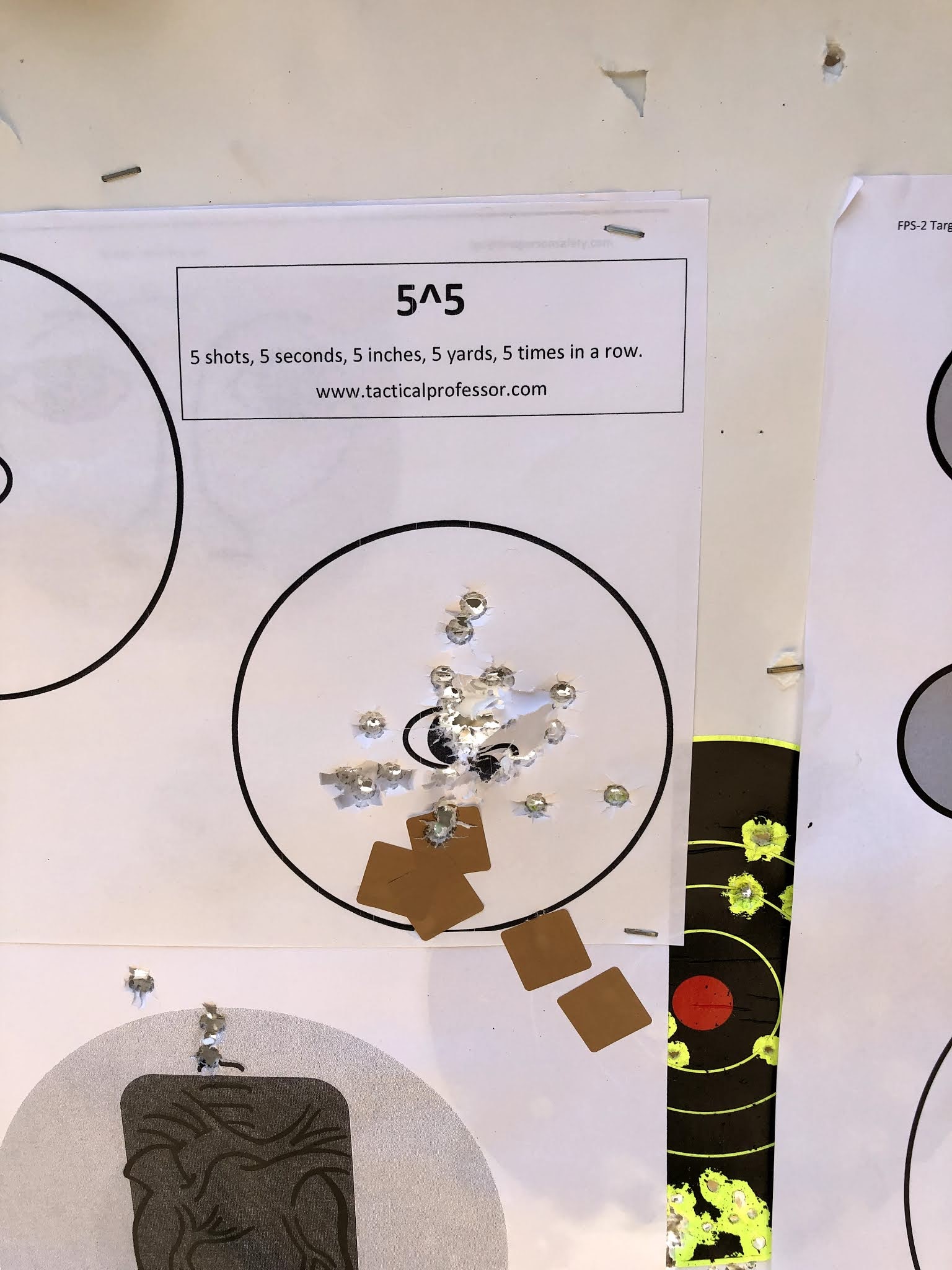
I then moved on to some distance work working a steel sillouhette and plate rack from fifteen yards. Steel doesn't lie to us. I had some misses on the plate rack. This prompted me to run a walk back drill starting at three yards, fire two rounds, evaluate, then move back one yard and repeat. At six yards I noticed the point of impact dropping. At thirteen yards the point of impact was six inches low. This concluded the fifty rounds of Barnaul. I then swapped to Monarch 115 grain, steel case, laquer coated ammunition. I repeated the walk back drill and noted the same changes to the point of impact at six yards and stopped at thirteen yards again with the point of impact still six inches low. I wanted to swap things up a bit and ran the IDPA 5x5 Classifier. As I didn't have a holster I started from a high, compressed, ready position. I was timing and tracking for a baseline of performance, not to classify so felt as if the holster wasn't relevant at this point. Times and scoring were as follows: String 1: 3.64/-1 String 2: 5.56/-1 String 3: 11.97/-1 (While I didn't think a holster was relevant a mag pouch would have been handy here.) String 4: 4.20/-4 The raw time was 25.37 and the adjusted time was 32.37. Not stellar but certainly a good point to work from. The remaing rounds were used on a steel sillouhette at fifteen yards. This concluded the first 100 rounds fired with functional issues.
Monday, August 2, 2021
The Infamous Remington R51
![]() |
I am hard pressed to come up with a firearm that was such a complete and total commercial flop as the first generation Remington R51, 9mm pistol. The stigma that follows these pistols rivals that of the Colt All American 2000, Zip 22, S&W Sigma, anything made by Jennings, Davis, Rohm, Jimenez, and Charter Arms. Why all the hate?
Remington invited a slew of gun writers to review their new R51 at a special even held at the prestigious Gunsite Shooting Academy. The reviews were glowing, giddy, and gushing. There was nary a bad word to be said about Big Green's latest attempt to garner a share of the pistol market. Once the productions guns hit the shelves however, the bloggers and social media reviewers started observing a plethora of issues. Sights falling off the gun, Failures to Feed, Failures to Extract, pins drifting loose, magazines dropping loose, and even reports of unintentional discharges. The gun buying public was outraged, with good reason. Customers were trying to determine how a firearm that received such glowing, gushing reviews was such a failure.
In short order the inevitable accusations were made. Gun writers and magazines were accused of writing false reviews for money. Counter accusations were made that the integrity of gun writers was unassailable and those making the accusations were petulant children, then that Remington misled the gun writers by stocking the event with hand built, pre-production pistols, rather than production units pulled off the line. Within five months Remington issued a complete recall of the R51. Owners were offered a replacement Gen 2 R51 with two extra magazines and a Pelican case, a replacement R1 1911, or a complete refund.
Two years later, in August of 2016, Remington started to roll out the Gen 2 R51s with little to no fanfare. The external changes were a relocation of the logo, set screws in the front and rear sights, and a thicker magazine base pad. The internal differences were numerous. The included a redesigned disconnector, redesigned breech block, knurled pins, a heavier action spring, redesigned ejector, and much better machining overall.
I've wanted to get my grubby mitts on a R51 since they first came out. I was fortunate to miss out on the FUBAR of the original guns. By the time Remington had started to release the second generation pistols my interest had moved on to something else, mainly because of all the distrust we as gun buyers had of the product and of Remington. This past week a local gun store listed a later production model as used-but-doesn't-look-fired for a decent price. I decided to take the plunge and see what I could determine on my own.
![]() |
| R51, Crimson Trace laser, and two magazines |
My R51 came with two seven round magazines, a Crimson Trace trigger guard mounted laser, the box, paperwork, and the obligatory and completely useless lock. I was pleased to see that the laser printed directly in line with the front sight starting at two yards. I manually cycled dummy rounds without an issue with both magazines. I then proceeded to field strip the pistol for a quick inspection...well not really. What actually happened was that I had to watch a couple Youtube videos to remove the slide from the frame. This pistol is based on a 103 year old design that never caught on. While innovative and functional, it is NOT intuitive.
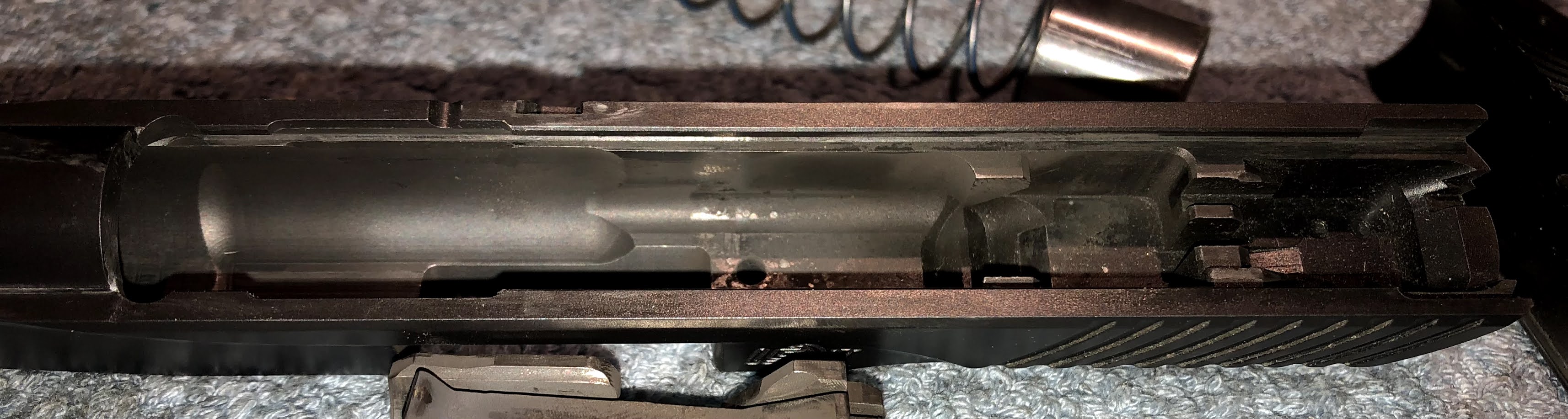
As I was doing my due diligence and researching the R51 one of the recurring themes I noticed mentioned was deformation on the ramps of the breech block and the shelf of the frame where the breech block rests. I noticed some deformation on the breech block ramps once the gun was field stripped. I regret not taking pictures at that time prior to my trip to the range. After 100 rounds there was no discernible difference. There was only some loss of finish on the shelf of the frame.
![]() |
| Deformation of breech block ramps. |
![]() |
| Finish loss on frame shelf. |
There was also signs of wearing and deformation on the frame rails. Again my hope is this will go no further. Time and more rounds downrange will tell. A couple of the vloggers mentioned that Remington said the R51 had a 100 round break in. I can find no mention of that in the owner's manual. My goal is to run 500 rounds through the pistol with no issues. I'll clean it and inspect it every 100 rounds unless there's a major issue that requires immediate inspection for safety.
![]() |
| Slight deformation on frame rails. |
Sunday, June 7, 2020
Things That Actually Served Me Well
So what served me well? Here's a short list of items I used.
iPhone8:
We live in a digital age where everything is interconnected. I was actually looking forward to unplugging from the world while exploring the national parks of Kenya. As fate would have it, there was almost no place that I was not connected. Imagine if you will, riding in the back of a Land Cruiser, poised to take a shot of giraffe and zebra, when your son texts you from 8000 miles away to complain about his car acting up...
While that part was a bit of a let down, the ability to access the web was handy while traveling. Pulling up maps, navigating Heathrow, navigating the Tube, taking short videos of wildlife and the countryside, using the phone as an alarm, listening to music, watching movies, and even tracking finances were all done with our phones. Most any quality smartphone would suffice. My company uses iPhones so I use one for my personal use for consistency and convenience.
Carhartt Clothing:
Specifically a hat and a couple pair of cargo shorts. The hat was Carhartt's Odessa Hat. I was specifically looking for something that didn't have bright colors, was washable, packable, and low key.
| Carhartt Odessa Hat and WileyX Hayden glasses. |
Eyewear is a rather subjective topic. I was looking for something that I could use on our trip for eye protection, use at work for eye protection, use on the range for eye protection, and still be able to use my prescription. I do not wear contacts so my choices are somewhat limited. The WileyX Hayden glasses fit the bill quite well with the added benefit of having transitional, polarizing lenses. I found them to be heavy for prolonged wear and the curve of the lenses create a blurred area at the edge of my peripheral vision, both of which are limitations however, I wear them daily at work and when I go to the range and have been quite satisfied with them.
Merrell Moab Hiking Boots:
I really thought we were going to spend a lot more time walking than we did. Most of our foot travel was getting through airports and moving from our vehicle to various structures. The most walking we did outside of moving through the various airports was a short visit in London. I had spent a a fair bit of time prior to our trip walking and breaking in my Moab boots. They did quite well on the trip and have seen much harder use at home than traversing the 'wilds' of Africa.
Columbia Ultimate ROC Pants:
Quite easily some of the most comfortable pants I've ever worn. I've used the original ROC pants at work and they held up much better than I expected in a trade that tends to eat pants and spit them out ripped and torn. The Ultimate ROC Pants were comfortable for moving through the airports, long flights, long rides in Land Cruisers, getting in and out of those same Land Cruisers, and were nice enough for casual wear to dinner. I'm still using the same two pair I took with me and they have held up well. The right, front, zippered security pocket was great for stowing my wallet so I didn't have to worry as much about pick pockets while in crowded areas.
5.11 Covert Boxpack:
I didn't use the Covert Boxpack much on the trip to Africa but used it while there and on the return trip home. I'm not all that thrilled over the black interior of mine, especially in the Admin section of the pack. It makes it very difficult to find items without using a flashlight. With that being said, it was an excellent option as a carry-on pack and for navigating the wilds of international airports. It also served well as our tech gear bag while traveling around Africa. Since being home I've used it for several weekend jaunts and for a couple of clamping trips with relatives. It's an excellent 24 hour pack at roughly 1800 cubic inches or 30 liters.
Damn the Spammers! Half speed ahead!
Thanks for your patience.
Sunday, May 3, 2020
10 Shots Quick!
During those trials the US Army sent out invitations to twenty manufacturers to submit a pistol or revolver design for testing. By the end of the testing the only remaining contestants were what became the Colt Model of 1911 and the Savage Model 1907. Both pistols were chambered in 45 ACP per the specifications. The Colt pistol was adopted and went on to serve with the US military through two world wars, Korea, Vietnam, and various other conflicts.
![]() |
| Savage model 1915 on left, Savage model 1907 on right. |
Savage on the other hand, never produced any of their .45 caliber pistols other than those for the trials. Instead the decision was made to use the lessons learned during the pistol trials and sell the same guns in calibers .32 ACP and .380 ACP. Savage had one of the most aggressive marketing campaigns f the time and made use of endorsements by such notables as Wild Bill Hickok, Bat Masterson, and Dr. Carver, who was a noted wing shooter at the time. Much like recent advertising slogans that have become part of pop culture, Savage's "10 Shots Quick!" was a recognized, household term at the time.
The decision to pursue commercial rather than military sales and the aggressive advertising campaigns were ultimately successful. Around 200,000 units were sold between 1907 and the late 1920s, including just under 30,000 sold to the French and Portuguese militaries. Even the 288 .45 caliber pistols were resold commercially.
The Savage 1907 came on my radar when watching Road to Perdition, a 2002 movie about an on the run mob enforcer played by Tom Hanks who's son witnessed a murder. One of the assassins sent after them, played by Jude Law used a Savage 1907. I thought it was one of the most stylish pistols that I have ever seen. The term "Art Deco before Art Deco was cool" has been used to describe the little Savage pistols.
![]() |
| "Art Deco before Art Deco was cool." |
![]() |
| Savage 1907 in .32 ACP made in 1913. |
Savage spent a LOT of time and effort advertising their pistols as premium, defensive pistols. In order to test that claim I used a modern shooting drill, electronic timer, and a IPSC target to test the viability of the pistol for defensive use. I used the IDPA 5x5 Classifier as a baseline and shot it from seven yards instead of the proscribed ten, mainly due to the minuscule sights on the gun. I do not have a suitable holster and those were not considered as important to the use of private citizens as we prefer now. Since it was advertised as a pocket pistol I worked out of a pocket with a loaded magazine, chamber empty. I'm only willing to trust the mechanical safeties of a 107 year old pistol so far. Additionally, the Safety Lever was designed for right handed use and I'm left handed, so chamber empty it was.
The ultimate conclusion was...it's viable a defensive pistol, even by today's standards. I shot this drill cold taking only three shots to verify function, accuracy, and feeding. The times were extremely slow. Drawing from the pocket and chambering a round, then acquiring a sight picture and decent trigger press was tough to start off. Stage 1 required 5.4 seconds to run through that process. By Stage 4 I had pared it down to 3.24 seconds. Splits (the time between shots) were also very slow by today's standards, the average of splits on the first stage was 1.69 seconds. By Stage 4 that had been whittled down to 1.04 seconds. Neither is all that great however, keep in mind I ran this cold, with an unfamiliar gun with a very stiff trigger. Those times could be worked down to an acceptable level. A decent holster would get the presentation to the first shot down to well under two seconds and I would be satisfied with .40-.50 splits.
| Results of the modified IDPA 5x5 drill from seven yards. |
Author's note:
I edited this post due to the cumbersome wording and numerous spelling mistakes. My apologies and thanks for those who managed to work their way through the first writing.
Saturday, April 4, 2020
Beretta M9
![]() |
| Beretta M9 |
One of the many complaints about the M9/92 pistols is the size of the grip, especially for a pistol that originally only held 15 + 1 rounds of 9mm. I was not at all happy with the size of the grips and the difficulty I had getting a solid grip. The alternatives were to modify the existing grips or purchase thinner grips. There are several companies making G10 grips so I decided to take that route. I chose, with my wife's help, a set of grips from Cool Hand Gear.
![]() |
| M9 with Cool Hand Grips |
Even with the D Spring I was having difficulty managing the trigger. This was a bit of a departure for me as I have a lot of experience shooting double action revolvers, TDA pistols, and Double Action Only pistols. After running 1024 rounds through the pistol and still not having the trigger management I preferred, I installed a 13# Hammer Spring from Wolff Gunspring. The next 103 rounds of 9 mm and 300 rounds using a 22 caliber upper were much more pleasant to shoot.
So in order to make the pistol shootable for me I had to install a thinner set of grips. They still require some modification to fit me better. I also had to drop the Hammer Spring down to 13#s. Of course I did my usual modification of painting the front sight and blacking out the dots on the rear sight. So to make the M9 suitable for my purposes I've invested an additional $40 in gun parts. The 1127 rounds of 9mm and 300 rounds of .22 are difficult to track for investment so I'll leave that out. I'll also do a separate post on the .22 upper.
Sunday, September 1, 2019
Beretta 81 Cheetah First Shots
Thursday, August 1, 2019
This Thing Has Served Me Well.
I used to think to myself that I wish I had such and such a thing that would last me thirty years and never fail. I'd save my money, get one of those things, start to use it and it would fail. Then I started asking questions. "What were the conditions in which you used it?" If it were a gun. "How many rounds through it?" "Do you attend training classes or shoot matches?" If a knife. "How often do you sharpen it? What sort of cutting tasks to you use it for? I started to notice that many times the answers were either vague, defensive, or in a few cases, grandiose. Such as. "I've probably got 50,000 rounds through this gun. Never had a jam. Not once."
Occasionally the standards are much lower than mine. "I shoot 100 rounds per year out of my self defense pistol. I've hunted grouse with this shotgun for thirty years and it's never failed me." Some times what's left out is more important than what is said. Grouse for instance are skittish birds and one rarely shoots more than three or four in an outing.
If you've made it this far you're probably wondering what brought on this latest Wheeler Diatribe. I've just returned from my first and hopefully, not my last trip to Africa for a photo safari. I took a few knives with me, one of which is an original DPx HEST. When I mentioned it to a friend prior to leaving he said. "That should serve you well." He was absolutely correct. It did serve me well and I was glad I had it. Truth be told the only time it came out the sheath was when I was attaching and detaching it to and from the MOLLE panel in my murse. That's right. I didn't use it once. I did most of my cutting and knifely tasks with a Case Sod Buster Jr. But now when asked I can say. "I took my DPx HEST to Africa for ten days and it served me well. :)
Monday, April 29, 2019
Are Revolvers Relevant? Part 3
Pros:
- Simplicity of operation
The epitome of the point and click firearm. No external safeties to disengage.
- Resistant to neglect
It's not uncommon to find a loaded revolver in a glove compartment or sock drawer that has been there for decades and will still function without issue.
- Less prone to negative effects from pocket carry
Pocket lint can clog up a small semi auto to the point that it won't function after the first shot. The resistance to pocket lint applies more to Centennial style revolvers than those with exposed hammers.
- Inherently accurate
A fixed barrel helps with accuracy. This doesn't mean that all revolvers are more accurate than other pistols, just that most are accurate enough to be useful as a defensive tool at distances out to twenty yards.
- Less prone to ammo sensitivity
You can load up each chamber with a different load from a different manufacturer and not have one affect the subsequent function of the next, unlike semi auto pistols that rely on a certain amount of force from the fired cartridge to reliably cycle the next.
- Easy to clear failure to fire procedure
Cartridge doesn't go bang? Hard Primer? Press the trigger again. Not many semi auto shooters can boast less than one half second to clear a Failure To Fire.
- Vast array of grip options
There are entire companies devoted to making grips or stocks for revolvers. While it might be difficult to find options for some of the newer designs on the market, it's usually possible to adapt a revolver to various hand sizes and preferences.
- Less prone to feed issues in confined spaces or entanglement
It's almost impossible to grasp a revolver and keep it from firing. It's also not as prone to interference from clothing.
- Long trigger press
There's a sizable segment of serious students of defensive pistol craft that prefer a longer trigger press. This helps provide one with time to think while under stress.
- Can be fire from within a pocket
I kept this separate from enclosed and entangled spaces because many people prefer to carry a small revolver in a jacket pocket.
The epitome of the point and click firearm. No external safeties to disengage.
It's not uncommon to find a loaded revolver in a glove compartment or sock drawer that has been there for decades and will still function without issue.
Pocket lint can clog up a small semi auto to the point that it won't function after the first shot. The resistance to pocket lint applies more to Centennial style revolvers than those with exposed hammers.
A fixed barrel helps with accuracy. This doesn't mean that all revolvers are more accurate than other pistols, just that most are accurate enough to be useful as a defensive tool at distances out to twenty yards.
You can load up each chamber with a different load from a different manufacturer and not have one affect the subsequent function of the next, unlike semi auto pistols that rely on a certain amount of force from the fired cartridge to reliably cycle the next.
Cartridge doesn't go bang? Hard Primer? Press the trigger again. Not many semi auto shooters can boast less than one half second to clear a Failure To Fire.
There are entire companies devoted to making grips or stocks for revolvers. While it might be difficult to find options for some of the newer designs on the market, it's usually possible to adapt a revolver to various hand sizes and preferences.
It's almost impossible to grasp a revolver and keep it from firing. It's also not as prone to interference from clothing.
There's a sizable segment of serious students of defensive pistol craft that prefer a longer trigger press. This helps provide one with time to think while under stress.
I kept this separate from enclosed and entangled spaces because many people prefer to carry a small revolver in a jacket pocket.
Cons:
- Limited on board ammo
Even the larger guns only carry eight rounds of ammo.
- Long trigger press
The length of travel and relatively heavy weight of a double action revolver trigger can be hard for some to learn and master.
- Relatively heavy
Most revolvers weigh more than their similarly sized semi auto counterparts.
- Slow reloads
Very few revolver shooters can reload as fast as a semi auto shooter.
- Reloads revolve around loose ammo
Revolver reloads require getting each cartridge properly aligned with each chamber.
- Can't mount a WML
With the exception of only a couple of designs, revolvers don't come with picatinny style rails. There are some grip options that provide a light that do not have much of a following.
- Less accepting of abuse
You can run a quality semi auto hard with minimal maintenance and expect thousands of rounds without issues. Not so with a revolver.
- More felt recoil
The lack of a reciprocating slide and recoil spring mean that only the weight and mass of a revolver provide recoil absorption.
- Major jams require tools to correct
A high primer or bullet jumping the crimp will lock up a revolver to the point that hand tools will be necessary to correct.
- Relatively expensive
Revolvers typically cost more than their equivalently sized, semi auto counterparts.
Hang around gun stores, shooting ranges, or firearms related pages on the internet and you'll most likely hear some well worn sayings like the following in regards to double action revolvers.Even the larger guns only carry eight rounds of ammo.
The length of travel and relatively heavy weight of a double action revolver trigger can be hard for some to learn and master.
Most revolvers weigh more than their similarly sized semi auto counterparts.
Very few revolver shooters can reload as fast as a semi auto shooter.
Revolver reloads require getting each cartridge properly aligned with each chamber.
With the exception of only a couple of designs, revolvers don't come with picatinny style rails. There are some grip options that provide a light that do not have much of a following.
You can run a quality semi auto hard with minimal maintenance and expect thousands of rounds without issues. Not so with a revolver.
The lack of a reciprocating slide and recoil spring mean that only the weight and mass of a revolver provide recoil absorption.
A high primer or bullet jumping the crimp will lock up a revolver to the point that hand tools will be necessary to correct.
Revolvers typically cost more than their equivalently sized, semi auto counterparts.
Misconceptions
- Six For Sure!This refers to the common belief that the first six shots of a six shot revolver will fire without fail. This came about during the first few decades of semi auto firearms development when things were still getting figured out.
- Revolvers Don't Jam!Similar to the Six For Sure concept that revolvers aren't prone to ammunition failings. In fact most serious revolver shooters have seen that this is not always the case as high primers, bullets jumping the crimp, or moving forward out of the case, dirt and trash under the extractor star, and the extractor rod working loose can and jam a revolver to the point that tools or even a gunsmith are required to correct.
- Revolvers Are More Accurate
Again this harkens from the days when gun designers were still figuring out what worked and what didn't as well as ammo design. The belief that a revolver with a fixed barrel is inherently more accurate than a semi-auto. Nowadays we've learned that there are many variables that affect accuracy and it's much easier to produce a very accurate semi auto than revolver. - Revolvers Are Simpler
Not in the slightest. Double Action revolvers are complex machines made up of many moving parts which typically require hand fitting for all to operate properly. - Revolvers Are Suitable For Novice Shooters
That's a grey area. Revolvers require work to learn to shoot well. While it's true the manual of arms is simpler, the actual process of shooting, sight alignment, trigger press, maintaining sight alignment during trigger press, and follow through is typically harder for newer shooters to gain rapid proficiency with. - Revolvers Are Better For People With Limited Hand Strength
There are a lot of folks that assume that if one doesn't have the necessary hand strength to cycle the slide on a semi auto pistol that a double action revolver with a 12-15# trigger weight will be a suitable alternative. - Revolvers Fit Small Hands Better
This is another grey area. There are a lot more choices for grips or stocks for revolvers than semi-autos, this provides myriad options for shooters however, this statement is usually used in reference to the typically smaller hands of women who are then told that a light weight J frame in .38 or even .357 is what they need. Those guns are brutal to shoot and people that recommend them to new or casual shooters are destined to the same pit of hell as those who talk in the movie theater.
Friday, April 26, 2019
S&W Model 67 Sight Insert Repair
Baughman's ramp saw further adaptation in 1952 with the addition of a dovetail cut in the ramp and a red colored, plastic insert installed. Called the Blanchard Front Sight many shooters have found this to aid the rapid acquisition of their sights and prefer this option. S&W has installed thousands of these types of Blanchard Sights on all of their revolvers over the past seventy seven years.
Several years ago a friend gave me a four inch model 67 that had seen better days. Among the signs of use was the red plastic insert barely holding in place. I had intentions of building it into an IDPA revolver and started the process of cleaning it up and had the chambers chamfered. I pulled out the insert and used some paint in the dovetail for the time being. I had intentions of filing out the dovetail and creating a semi Patridge style front sight but never got around to it. After shooting several matches I put the 67 away as personal commitments cut deeply into my IDPA time.
Fast forward to now and I've decided that I want to start shooting the 67 again. As I'm a bit more cognizant of the relative values of some of the older S&W revolvers I decided that I'd leave the forged front sight alone but wanted to fix the gaping hole left by the lack of the insert. Also, I don't like the red ramps.
![]() |
| View of the dovetail with paint. |
![]() |
| Side view of the dovetail. |
The first actionable step of any project is preparation. In this case I acquired some silicone sealant and orange paint. Then I had to clean the old paint from the dovetail and remove the remnants of the old insert.
![]() |
| Overhead view of the cleaned dovetail and retention holes. I have to wonder if all the holes are off centered or if mine is unique. |
![]() |
| Concoction of silicone and paint. |
![]() |
| Allowing the sealant to set. |
Once the concoction had set firmly enough to hold without the need of the form pieces, I removed the binder clip and leather and trimmed with an X-ACTO knife.
![]() |
| The final product. It's not perfect but acceptable for a first attempt.
There are a few steps left to turning this into a solid competition pistol. I'm going to disassemble the model 67 and install heat shrink over the trigger. This model had a serrated trigger that tends to abuse my trigger finger during longer range session or in matches. Claude Werner, aka The Tactical Professor clued me in to the use of heat shrink. Look forward to another picture heavy post when I take on this project in the next few weeks.
|
Saturday, April 20, 2019
S&W 43C Two Years Later
Think about that for a moment. Fifty. Years. Less than 100 shells. But guess what? That shotgun had served him well. It went bang every time he pulled the trigger. By any definition that is reliable service, even if it were an average of two shots per year.
If you've made it this far you're probably scratching your head, maybe rolling your eyes thinking that Wheeler Dood has finally let senility catch up to him and he's rambling. What possible relevance does an old, outdated shotgun getting shot twice a year have to do with a S&W .22 caliber revolver? In this case my ramblings are designed to illustrate a point.
I've shot and carried the 43C for two years now. Last year I ran 1,275 rounds through it. Most of that was bulk pack ammo, specifically the Federal Red Box sold at Walmart. There were 19 failures to fire, all ammo related. That's a 1.4% failure rate over all. At face value that seems questionable however, I also tracked the use of my carry ammo, specifically CCI Stingers.
At roughly $6.50/50 Stingers are rather pricey for 22 ammo but about half the cost of most 9mm bulk ammo. So of those 368 rounds of Stingers I fired I had 0 failures. None. Zilch. Nada. So when I say something like, "I've carried my 43C for two years and it has served me well..." Well, I might just know what I'm talking about.
So how has the 43C held up thus far? It's been pocket carried for those two years. When I say it's my EDC I mean it's actually carried every day. It's not part of the rotation, it doesn't get swapped out except at the range. It is my primary carry the vast majority of the time. When it's not my primary, it's because it has become my secondary or tertiary lethal force option. In other words I'm wearing a pistol in a belt holster and carrying a long gun.
I've swapped out the OEM stocks for a modified set of DeSantis Clip Grip stocks. There is lead build up in the opening of the shroud surrounding the muzzle. I've shot it from contact distance to 100 yards. At fifty yards I can place all eight rounds on a USPSA Practice Target. At fifteen yards I can place all eight in the B zone of the head box. I've cleaned the TDA Dot Torture with it five times at three yards and shot a 49 from five. My point is not to brag about my abilities but to point out the accuracy and reliability of the ultra light J frame.
Wednesday, April 17, 2019
Are Revolvers Relevant? Part 2
When discussing the revolver as a viable primary lethal force option, what usually crops up are instances, real or imagined, of fighting off multiple attackers and the need for more on board ammo, relative size, relative weight, relative speed of reloads and the need or lack of need for a reload, so forth and so on. So why in the world would anyone choose a firearm that has remained virtually unchanged in over 100 years, with a relatively inferior cartridge, as their primary means of lethal force?
Let's start off with comparisons.
Size:
![]() |
| A CZ P-07 and S&W 631. There's not a lot of difference in size |
![]() |
| CZ P07 and S&W Model 10. Once the standard for a police sidearm, the 4" small frame revolver has been supplanted with a compact pistol. |
![]() |
| Model 10-8 with six rounds of .38 Spl 158 grain +P LSWCHP. |
![]() |
| P-07 with 15 rounds of 9mm +P PDX JHP. |
Accuracy and Reliability:
With the glaringly obvious differences is weight and on board ammunition capacity it would seem that there is a fairly strong argument for the P07 or a similarly sized pistol. What about accuracy? Reliability? Ease of use?I've found both both to be very accurate. Accuracy is partially ammo dependent however, with good loads either pistol is capable of good accuracy at ranges out to twenty yards. I haven't tested either further than that at this point.
Both guns are quire reliable. Ammunition is once again a large part of reliable function. The use of good ammo has shown me that both guns are quite dependable.
Ease Of Use:
Ease of use is very subjective and covers quite a few specific fundamentals.- Trigger Press/Pull
Many people struggle with the long and sometimes heavy trigger pull of a double action revolver and will turn to striker fired pistols such as a Glock or M&P to address that particular issue. Picking a gun that has a relatively easy trigger press to master allows one to concentrate on other areas, such as proper sight alignment, follow through, manual of arms, reloading, etc. Many if not most firearms instructors prefer striker fired pistols for their students as it makes it easier to teach fundamentals.
A double action revolver on the other hand, has a long distance of trigger travel before the sear is tripped and the hammer drops, firing the gun. One must concentrate on the fundamentals mentioned above while trying to learn that particular trigger press.
- Sights and Sight Alignment
Both revolvers and semi autos typically have what is referred to as a notch and post style sighting systems. I do realize that current advances in dot style systems have been made and are gaining acceptance in many circles. I may address that particular system at a different time but, don't feel as it's relevant to this particular discussion.
Most fixed sight revolvers such as our Model 10-8 have a rear notch that is cut in the frame and a Baughman style ramp sight out front. The Bauggman Ramp was conceived prior to WW2 and was a vast improvement over the half moon style front sight of the time. When viewed from the rear it appears to be a square post much like a patridge sight.
Semi autos intended for defensive or combat purposes come with a plethora of sighting options. Most are still a notch and post setup with a squared off front sight post.
At first it would seem that both are close enough to not matter however, many shooters complain about the difficulty in getting a good sight picture with a narrow rear notch and ramp style front sight. Notch and post sighting systems require the shooter to be able to get a crisp view of the front sight when aligning the sights on the target. That usually requires the rear notch has to be wider than the front post to allow enough light on both sides of the post to provide good contrast. Sound complicated? The science of it is, the end result for us as shooters is not. Most folks determine what works best for them through trial and error.
- Fitment to hand
The ability to properly grasp a handgun and fire it while maintaining control can not be over stated. Revolvers have long held an advantage in this area. With a design that has remained relatively unchanged for 120 years the options for grips, or what is more properly referred to as stocks are virtually unlimited.
Manufacturers of semi auto pistols have only recently acknowledged this deficiency. The old response was to purchase a different sized pistol that might fit one's hands well enough that they could learn to use it adequately. More credence has been given to the necessity to proper hand fit with various grip adapters, palm swell panels, back straps, and in the case of some of the more modular designs, entirely different frames. The widespread acceptance of various polymers for inexpensive frame construction has more likely been the impetus for this nod by the industry to closer meet the needs of their consumers.
In conclusion both guns are relatively easy to shoot, albeit the revolver takes more effort to learn to shoot well, accurate, reliable, and weigh about the same to carry. At this stage the only difference that isn't subjective is the amount of ammo one can carry on board. An astute reader may have noticed that I have left out the speed and ease of reloads as well as carrying spare ammo. That's another conversation entirely that I hope to address in future writings.
I had hoped to cover both the Pros and Cons of revolvers in this post. As I started writing I realized that to cover this with any level of detail wasn't going to happen in a typical blog post. The next segment will be broken down into the actual Pros and Cons.
Friday, March 8, 2019
Are Revolvers Relevant?
The definition of relevance according to Merriam-Webster is;
b: practical and especially social applicability.
2: the ability (as of an information retrieval system) to retrieve material suitable to the needs of the user.
What does that mean to us?
1 a: Does the use of a revolver relate to the matter at hand, specifically that of self defense?
1 b: Is a revolver practical and especially socially applicable?
2: Does a revolver provide the needs of the user?
Those three questions are the crux of the arguments. Let's address them one at a time and see what we can come up with.
1 a: Does the use of a revolver relate to the matter of self defense?
Most assuredly. As Responsible Armed Citizens we should make sure that we are well aware of all the limitations.
- The limitations of our preferred primary lethal force option.
A: Is it accurate, reliable, provides decent penetration?
A: Can you deploy, aim, shoot, and manipulate it safely, accurately while under stress?
If a revolver fits those criteria, then it checks that box.
1 b: Does the revolver provide the needs of the user and is it socially acceptable?
This is where we have to start making our own decisions. Assuming we have an accurate, reliable revolver that we can carry, draw, manipulate, and shoot both safely and well, will it fit our needs? It has been my experience that the more proficient one is with a given tool, the more one can accomplish with said tool.
Is it socially acceptable? In today's culture of loathing for guns a revolver tends to draw less negative attention however, the potential negative attention should be pretty far down your list.
2: Will a revolver fit your needs?
Again this is subjective. You will have to determine your needs. You may find out that your needs change from time to time and would prefer options. You may start off with one type of pistol and caliber only to discover that it doesn't fit your needs. Proficiency is the key. Learn to use your tool.