Thursday, September 22, 2016

Homefront Shotgun Class Review

I had the opportunity to attend an innagural basic shotgun class recently put on by Lee Weems of First Person Safety.   Lee is the Chief Deputy of a Sheriff's Office in Georgia.  His resume of firearms related training is quite extensive and varied.  As an individual that hangs around the periphery of the firearms and training community, I can attest that he has availed himself of some extremely talented and qualified instructors.

The class was billed as a "basic skills course that will progress into challenging drills."  As an avid shotgunner I found quite a bit of useful information in both the lecture portion, dryfire portion and the livefire drills.  The class was divided into Lecture, Demonstration, Dry Loading And Unloading, Dryfire with various loading drills, Live Fire, Advanced Live Fire Drills, Class Competition, Patterning With Buckshot, Range Cleanup, Final Lecture, and a Class Review.  For those that care about such things, those titles are mine and not part of a current course description.

Lecture:

After an initial introduction and safety brief we started with the lecture and Q&A.  This portion of the class covered some history of the shotgun and a rather extensive review of the various types.  As Lee pointed out multiple times, training with shotguns is rather difficult due to the various loading and unloading procedures, safety locations, capacities and action types available.  He spent the time to discuss this in great detail which served us all quite well during the hand's-on portions of the class.  While a bit monotonous, this was very necessary information.

One very important point brought up during this phase was that the safeties on shotguns are trigger block safeties.  That means that shotguns aren't drop safe.  We then moved into proper loaded storage of a shotgun, which is termed Cruiser Ready, Storage Ready, and Gunbox Ready.  Those are all terms that Lee has come across in his training and mentioned them as students that choose to further their training may come across them in the future as they are interchangeable.  His preferred term was "gunbox ready."  He also recommended to keep the magazine downloaded by one round to save the magazine spring.  In other words, if the magazine of your shotgun holds seven rounds, only load six and leave the chamber empty.  An added benefit is that should one choose to insert a slug in the magazine prior to cycling a round in the chamber there was space in the magazine to do so without removing existing ammo.

On a personal note, I own or have shot multiple brands and styles of shotguns in action style competitions, hunting, sporting clays, skeet, five stand and plinking, if one can legitimately plink with a shotgun.  The various loading and unloading procedures as well as the manual of arms, even with shotguns from the same manufacturer can be mind boggling.


Demonstration:

Shotguns are notable for their recoil.  Learning to properly adjust one's stance and how to correctly mount, or hold the shotgun while shooting makes the experience much less an ordeal.  Weight and body mass tend to help with the absorption of recoil as well as the type of shotgun one is using.


Dry Loading And Unloading:

Lee strongly recommended the use of sidesaddles or butt cuffs for extra ammo storage.  He provided each student with four inert or dummy rounds for hands-on practice of loading, and especially unloading a shotgun safely.  Break action shotguns are easy.  Shotguns with tubular magazines are a bit different.  Rather than cycling the shells through the chamber and using the extractor and ejector one can use the shell stop to extract the rounds.  In the case of some of the newer semi auto shotguns, there are buttons that allow the user to release all the shells at once.

Dryfire:

After all the students exhibited proficiency with the loading and unloading methods unique to their shotgun we started with the dryfire drills.  These were integrated with combat loading, or loading a shell through the ejection port, and speed reloads, in which the appropriate number of shells were inserted in the magazine to match the number of shells fired.  In other words, "Shoot one, load one.  Shoot two, load two."

Livefire:

It was finally time to make bang.  We started off with loading one round and firing and quickly progressed to working reloads, speed loads and combat loads from the sidesaddle.  All of this portion was done from the seven yard line on cardboard IDPA targets.

Advanced Livefire Drills:

As the drills progressed less instruction was given to the actual steps needed to take to keep the gun loaded.  It was up to the student to keep track of the status of the gun.  I don't mean to imply round counting so much as following the tenet of "Shoot one, load one."  We then participated in the drill known as Rolling Thunder.

Rolling Thunder is an extravaganza of shooting and reloading.  Every shooter starts off with fifteen rounds available.  One round is loaded into each chamber.  At the command to fire, the first shooter fires one shot, the second shooter fires one shot, so on and so forth down the line.  When the first shooter has fired his or her first shot, he or she then loads two rounds, as does the second, third and fourth, et cetera.  When the last shooter on the line has fired their one shot, the first shooter then fires their two shots, as does the second, third until the last shooter.  Meanwhile the first shooter has now loaded three rounds.  This continues until everyone on the line has loaded and fired a set of five rounds.

I found this drill to be a good test of one's ability to keep track of the status of their shotgun, remembering how many shots they had fired and needed to load, a small bit of situational awareness, reloading technique, and how hard one could run their chosen shotgun.  It was also a lot of fun!

Class Competition:

Another bit of fun with some added pressure.  This drill had everyone place their shotgun in Cruiser Ready.  For the purposes of this exercise that was four rounds in the magazine, chamber empty.  Five steel targets were setup at fifteen yards.  Using a shot timer an audible start signal was given and the participant would shoot four of the five steel targets, perform a combat reload, then shoot the fifth target.  For students who had never shot in front of a group of critical peers with a timer tracking their performance, the experience was eye opening.  It has been noted by several high level trainers that the introduction of a shot timer places a completely different level of stress on the shooter.  The use of one is also a good litmus test of where one's skills are.  

Patterning With Buckshot:

The class was conducted as a basic familiarization on shotguns for the purposes of home defense.  Buckshot is the single best option for this purpose.  There was some minor discussion on the various types and weights of buckshot and some technical pros and cons.  Lee is a big believer in using the Federal Flight Control 00 Buck.  The eight pellet Flight Control tends to hold a tighter pattern than time honored nine and ten pellet 00 Buckshot.  Having observed two students in the class using the Flight Control I am a believer.

We patterned from seven, ten, fifteen, twenty and twenty five yards and examined each group for flyers, or stray pellets to have an idea of the limits of effective range on our chosen loads.


Final Lecture:

After the range cleanup we sat down for another lecture which was essentially a recap of the class.

Class Review:

Lee asked us for our input on what could be done better and welcomed constructive criticism.

In conclusion, I thoroughly enjoyed this class.  If you're in the market for a shotgun for the purpose of home defense I would suggest you give Lee and First Person Safety consideration for training.

Tuesday, April 19, 2016

A Well Regulated Militia...

The Second Amendment of the United States Constitution reads: "A well regulated Militia, being necessary to the security of a free State, the right of the people to keep and bear Arms, shall not be infringed."

What does that mean?  Those twenty seven words have been argued, misinterpreted, and even ignored by private citizens, the military and our elected representatives.  Where does one even start on how to interpret the meaning of those four phrases?

As I've matured as a gun owner, competitor, and hunter I've had the mixed blessing and curse of spending quite a bit of time around people who stress research and drawing logical conclusions based on forming an objective opinion.  So let's start off down this rabbit trail by trying to figure out what exactly the framers of that greatest of secular documents meant by the Second Amendment.

A well articulated article at lectlaw.com goes to great lengths to explain the meaning of the first phrase, "A well regulated Militia,".
"Thus, the well regulated militia necessary to the security of a free state was a militia that might someday fight against a standing army raised and supported by a tyrannical national government. Obviously, for that reason, the Framers did not say "A Militia well regulated by the Congress, being necessary to the security of a free State" -- because a militia so regulated might not be separate enough from, or free enough from, the national government, in the sense of both physical and operational control, to preserve the "security of a free State.""

The good folks at The Constitution Society had this to say;


"The phrase "well-regulated" was in common use long before 1789, and remained so for a century thereafter. It referred to the property of something being in proper working order. Something that was well-regulated was calibrated correctly, functioning as expected. Establishing government oversight of the people's arms was not only not the intent in using the phrase in the 2nd amendment, it was precisely to render the government powerless to do so that the founders wrote it."

In simple terms, well regulated means keeping your stuff in good, working order.  It does not mean nor imply any form of government oversight.  The lectlaw article continues to explain;

"By contrast, nowhere is to be found a contemporaneous definition of the militia, by any of the Framers, as anything other than the "whole body of the people." Indeed, as one commentator said, the notion that the Framers intended the Second Amendment to protect the "collective" right of the states to maintain militias rather than the rights of individuals to keep and bear arms, "remains one of the most closely guarded secrets of the eighteenth century, for no known writing surviving from the period between 1787 and 1791 states such a thesis.""


Stated a different way, there are no documents giving any credence to the idea that the National Guard or other armed body of individuals controlled by the individual states or the federal government were what the framers had in mind.

"Being necessary to the security of a free state," is really what, in my opinion as well as those of folks with much more formal education than I tend to believe the Second Amendment is really all about.  Context is everything when studying and interpreting historical documents.  These United States of America had just fought a difficult and protracted war with what was at the time the greatest military power on Earth, and won!  They were absolutely terrified of the thought of reverting back to the same political system with the advantages given to nobility, castes and monarchs.  Even more daunting was the thought of maintaining a large standing army that was solely responsible to whatever government replaced the old system.

These guys knew what evils lurked in the hearts of men.  Again from lectlaw;

"As Noah Webster put it in a pamphlet urging ratification of the Constitution, "Before a standing army can rule, the people must be disarmed; as they are in almost every kingdom in Europe." George Mason remarked to his Virginia delegates regarding the colonies' recent experience with Britain, in which the Monarch's goal had been "to disarm the people; that [that] . . . was the best and most effectual way to enslave them." A widely reprinted article by Tench Coxe, an ally and correspondent of James Madison, described the Second Amendment's overriding goal as a check upon the national government's standing army: As civil rulers, not having their duty to the people duly before them, may attempt to tyrannize, and as the military forces which must be occasionally raised to defend our country, might pervert their power to the injury of their fellow citizens, the people are confirmed by the next article in their right to keep and bear their private arms."

By referring back to the thoughts and writings of the original framers we can gather what their primary interests were, most notably to not have to fight another war to secure a free state, especially against an army of their countrymen, precisely what had been going on in Europe for centuries and indeed led to the horrors of World War One and World War Two. Our founding fathers sought to rise above those petty intrigues with the creation of a true republic in which the majority ruled while the rights of minorities were protected.

"...The right of the people to keep and Bear arms."  I can't fathom how this can be interpreted in any other manner than what it says.  The people, both collectively and individually have the right to own, bear, and store weapons.  There are no limitations here.  No qualifiers about hunting, defense from marauding Indians, nothing about cosmetic features or color, barrel length or overall stock length.  There are no limitations that describe small arms only either.  There's nothing that says a private citizen can't have a cannon, mortar, bombard, Puckle Gun, a Ferguson Rifle, a heavy machine gun or even a tank.  Let's remember the purpose discussed above.  "A well regulated Militia, being necessary to the security of a free State..."  People and equipment in good order capable of defending against a standing army turned against the people.

"...Shall not be infringed."  The term "shall not" is used in law books and codes though out the country at every level from the smallest town to the federal government.  Another way of saying this is, "Absolutely under no circumstances."  Infringed, according the the Merriam-Webster dictionary is defined as; 

"to wrongly limit or restrict (something, such as another person's rights)"

With any right comes responsibility.  Exercising our right to free speech to incite a riot or a lynching is irresponsible to say the least.  Owning and bearing firearms without being well regulated, or in good working order is irresponsible as well.  To expand on that thought even further, not only do we need to make sure our weapons are in good working order, but our ability to use them is as well.  That leads us into training.

I want to pause briefly and clarify that I am not advocating preparing for armed insurrection.  Taking up arms against our fellow citizens is an abhorrent idea.  Should that time ever take place we as responsible individuals should strongly consider the ramifications of such actions and only do so with great reluctance.  


Proficiency in safe storage,handling and the manual of arms (how to properly load, unload, clear malfunctions, zero, aim and fire,) should be first and foremost in our quest for training.  Once the basics are understood and put into daily practice then the more advanced methods should be pursued.  What exactly are advanced methods?    Loading, unloading, aiming and shooting from the Standing, Kneeling, Sitting, and Prone positions are the logical next steps.  Once those foundation blocks are laid and cemented we can move on to shooting while moving, proper use of cover, and accurately engaging targets at various ranges.  Shooting while under minor degrees of mental stress will quickly show flaws in our equipment and methods.  To that end participation in one or some of the various shooting competitions should be pursued.  

Another avenue to explore is seeking professional instruction.  I'll caution the reader to do so with caution.  The training community has numerous quality instructors and training organizations.  Unfortunately there are just as many, if not more that claim the title and teach utter bunk.  I'd recommend looking into the numerous NRA programs as well as the Appleseed Project to start off in basic firearms handling skills.  Ladies that are interested in training without the sometimes overwhelming levels of testosterone can look for a local A Girl With A Gun chapter.


Regardless of your purpose in owning a firearm, do take the time to maintain proficiency.

Thursday, March 24, 2016

Negligence and Responsibility

I came across a post today on social media about a man who's dog had been attacked by two Pit Bulls.  You can read the article for yourself here.  The man's Cocker Spaniel had been drug under a gate and was being mauled by the two larger dogs.  He initially yelled and ran towards the dogs which had no effect.  He then retrieved his .22 caliber rifle and fired multiple shots in the air to scare the Pit Bulls away.


It's worthy of note that the dogs didn't leave until his neighbor came outside and he fired the second series of shots in the air.  Mr Jefferson was soon after visited by and subsequently arrested by the local police.  He was later charged with Reckless Endangerment.  Why?  Firing shots in the air.  Had he shot the dogs he most likely wouldn't have been arrested.  Let's take a look at Cooper's Four Rules Of Safe Gun Handling and review how they apply to this situation.   
 

RULE 1

ALL GUNS ARE ALWAYS LOADED

It's unknown from the information provided by the article what state Mr. Jefferson's rifle was in before he retrieved it from his storage location.  For the sake of argument and what appears to be a relatively short period of time we're going to assume that the rifle was loaded and he was aware of it's status.  So far, so good.

RULE 2


NEVER LET THE MUZZLE COVER ANYTHING YOU ARE NOT PREPARED TO DESTROY

Now we're getting into what could be construed as a grey area.  I disagree with that assessment.  As we go through the next few steps in the process I'll explain.  Mr. Jefferson pointed his rifle in the air, or had it in a muzzle up condition.  On one hand he wasn't pointing it at anyone or anything so it's safe, right?  Wrong.  We're all familiar with gravity.  Without delving into the physics let's keep it simple, "What goes up must come down."  The $64,000 question is, where?  Muzzle safety is pretty cut and dried.  If you're not actively in the process of shooting at a target that you're willing to destroy then the muzzle is pointed in a safe direction.  Regardless of the time honored tradition of pointing the muzzle up, that's not safe, it's more along the lines of plausible deniability.

RULE 3


KEEP YOUR FINGER OFF THE TRIGGER UNTIL YOUR SIGHTS ARE ON THE TARGET

Sights were not used at all in this case.  Mr. Jefferson hadn't the foggiest notion of where his bullets were going on the way out of the muzzle nor where or what they would impact on their way back down.

RULE 4


BE SURE OF YOUR TARGET AND WHAT'S BEHIND IT

Finally, Mr. Jefferson had absolutely no idea of what his target was as he had no sight picture.

At face value this seems to be a hit piece about Mr. Jefferson and his irresponsible gun handling.  In fact nothing could be further than the truth.  I chose this situation because it hits home on several personal levels.  First of all I have had Negligent Discharges.  Yes.  Multiple instances although the particular situations were spread apart by twenty five or so years.  In the first I was a kid and lucky no one was hurt and no property was damaged.  The second would have been, as my good friend Claude writes about regularly, a Negative Outcome, had I not adhered to at least a few of the Four Rules.

Secondly, I have dogs.  I fully understand the emotional attachment and bond between humans and dogs.

Finally, I am personally aware of an instance that happened locally in which a similar scenario resulted in the attacking dog being shot and killed, legally.
What could Mr. Jefferson have done that would have resulted in a more positive outcome?

“It’s apparently illegal in Philadelphia to discharge a firearm in the air regardless of the situation which I was unaware of at the time,” Jefferson said.

Know your local and state laws.  Ignorance is no excuse.

Jefferson told NBC10 he thought he did the right thing by sending warning shots instead of shooting and possibly killing the pit bulls.

Again, know your laws.  What seems like The Right Thing may in fact get you in more trouble.

“I honestly had no idea that what I did was illegal and my only objective was to save my dog's life without harming my neighbor's dogs in the process which I actually accomplished,” Jefferson said. “When the detectives came they told me that I should've gunned down the two pit bulls to save my dog and I wouldn't have been arrested but that would've been animal cruelty in my opinion."
The litany of "I didn't know" continues.  The fact that this turns up three times in the same article should be a clue.  Mr. Jefferson's only defense is he was trying to do the right thing and he didn't know.

In my estimation, Mr. Jefferson suffered from situation overload.  First his dog is attacked, then after yelling and screaming had no affect on the Pit Bulls he retrieved his firearm.  Here's where things started to go really wrong.  Dogs are incredibly focused when attacking what they consider an intruder or prey, especially when they are in a pack environment.  They didn't perceive Mr. Jefferson as a threat when he yelled at them and when the gun shots didn't produce an immediate recognizable threat to them, they continued their attack.  It appears to me that he suffered from the common misconception that a firearm is a magic wand that one can wave around and produce results.

Mr. Jefferson was also worried about possible fallout from shooting the offending dogs.  I could belabor the point about knowing your laws but instead I'd like to pursue a different line of thought.

"...my only objective was to save my dog's life without harming my neighbor's dogs in the process..."

The above statement defines the biggest mistake with Mr. Jefferson's thought process.  He wanted to make the attack stop without hurting the other dogs and quite likely without upsetting his neighbors.  Folks, I can't repeat this enough, outside of responsible target shooting, using a firearm is a life altering event.  If his only objective was to save his dog's life, then the lives of the two attacking dogs should have been forfeit.  Future relations with the neighbor should not have been a consideration until afterwards.  Using a firearm in a defensive situation means we have to be prepared to kill something or someone.  Period. Dot.

We all react differently under stress.  Again, I don't condemn Mr. Jefferson for his actions, I'm merely using them to illustrate a couple of points that is all to often overlooked.  Guns aren't magic wands.  Using one defensively requires hard choices that probably will have negative results later on, which means that we have to be prepared to deal with the negatives and make sure the reason we're using a firearm defensively is worth the eventual problems that will come along later.  

Be prepared.
Get training.
Shoot some matches and learn to use a firearm under a little bit of stress.
Have some broad choices mapped out beforehand.
KNOW YOUR LAWS.


Tuesday, March 15, 2016

Introspective Thoughts

I found out early today that Todd Louis Green had passed away after a ten year battle with cancer.  For those that don't know who Todd was, check out http://pistol-training.com/.  Todd was a giant in the firearms training industry.  He had a distinguished resume and was a very accomplished shooter.  You can take a look at his bio here.

I never met Todd, never took one of his classes nor spent time with him on the range.  Nonetheless, through the mysterious magic of Al Gore's Internet I had talked with him on a few occasions...well, perhaps argued is a better term.  We didn't see eye-to-eye on several subjects.  I'd say that a lot of that comes from us being from different backgrounds, having different life experiences and different expectations, especially when it came to firearms.

After bandying words back and forth a few times with him across the magical light box I made up my mind that I didn't like him.  No real particular reason other than my stiff-necked Appalachian pride.  Which was really stupid on my part.  More on that later.

I have several friends that had met Todd.  They all spoke highly of him and mentioned what a great guy he was.  I wasn't having anything to do with it, I'd made my mind up and that was that.  Then I heard he had cancer.  That made me decide to quit arguing with him, or at least disagreeing with his points.  I mean, the dude has got more serious issues to deal with than my salient points on technical points of firearms and the handling of those particular models that I had experience with.

We met again in a facebook group.  I was using my real name instead of my typical forum handle.  The group is light hearted and fun, which makes me happy most of the time.  The interactions I had with him there were much more pleasant.  I decided that maybe I could bend a little bit and take him at face value.  I wish I had done that years ago.

In the end, Todd passed away after his long battle with a horrible disease.  We were the same age and that really struck a nerve.  While mulling over my own life choices and health issues I had another thought.  We as gun owners are a contentious and cantankerous lot.  It doesn't matter what group you invest your time in, there will be heated arguments over the relative merits of caliber, capacity, barrel length, wood versus synthetic furniture, Winchester versus Marlin lever actions, Colt versus S&W versus Ruger revolvers, striker fired versus single action versus double action versus double/single action triggers, steel versus polymer frames, ad infinitum.  In the end, what does it matter?

I missed out on the opportunity to learn from a man who had a wealth of experience.  I completely ignored what was probably the best piece if advice my mother ever gave me.  "You can learn something from every single person you meet, no matter how smart they are."  I allowed my pride to prevent me from learning from Todd.  No more.  "Pride goeth before a fall." is good advice.  I'd do well to remember it.

If you've made it this far through my ramblings, please take a few minutes to go to the Rampage For The Cure website.  Word has it that Todd and his family asked that any donations be given here.  Even if you don't donate in Todd's name, it's a worthy cause.

I'm also adding a link to the blog to the pistol-training website.  There is a wealth of good information out there, we just have to let it in.

Wednesday, February 4, 2015

Escaping Mob Traffic

I spend a huge portion of my work day driving around the Metro Atlanta area.  At any given time I can find myself upwards of 100 miles from home.  Given the nature of the type of work I do I might start off five miles from the house and within a few minutes get routed to a location seventy miles from home.  That has made me quite aware of the very distinct possibility of not being able to make it home at the end of the day.

Atlanta has some of the worse traffic in the country.  According to this article it's the seventh worse in the country.  What that means in practical terms is that a relatively small event such as a multi-vehicle wreck, or a fatality accident can have a ripple effect that can create congestion on all six interstates in the metro area.  I have sat in traffic for around three hours before because of a wreck, which induced another wreck, which in turn induced a third.  That's common in every major city in America.

Today there was a suspicious package taped to the side of the 14th Street Bridge which crosses over The Connector.  To those not from the area The Connector is the stretch of interstate where I85 and I75 merge.  The package was seen and called in, investigated and the authorities responded in a predictable manner.
The 14th Street Bridge was closed.
The Connector was closed.
Vehicles were routed out of the area regardless of the direction their drivers wanted to go.
Entrance Ramps were closed.
Side streets were suddenly deluged with many, many more vehicles and drivers that didn't really know where they were going.
The EOD guys showed up with their gear, did their due diligence and detonated the package.
All the pieces were picked up and the the interstates were slowly opened back up.
As of this writing, five hours later the commuters are still wending their way home.

I firmly believe the best way to avoid this type of hassle and the troubles caused by impatient drivers is to get in front of the wave.  In my case, I was approximately 600 yards from the bridge and the package working in a high rise, I was able to finish up what I was working on, get all my tools down to my van, get loaded up and take an alternate route past the blocked traffic, get back on the interstate and be home in an hour.  How did I accomplish this?

First I picked up on the conversations of folks around me.  Comments like "No trains, No buses, No cars, No Nothing!", and "It's a bomb threat! They've done shut down the highway and the bridge." brought me out of my work related focus and into what was going on with everyone around me.  People crowding the windows to see what was going on, hovering helicopters, then I saw the section of interstate that was closed.  I knew it was time to pack up and get moving.

I was fortunate in that I was able to finish what I was working on, pack up, make my way from the 17th floor to the loading dock, load up my van and scoot.  My fifty mile drive was accomplished in forty minutes. That's a record for Monday in Atlanta at 3PM.  My main concern wasn't the package that turned out to not be a bomb.  It was the thousands of frustrated and angry drivers that would be making a mad dash once the interstates were opened up again.  In my opinion, the best approach is to avoid that type of situation completely.  In case you can't, I'd suggest reading Greg Ellifritz's blog and especially his post on Mob Mentality.  Greg has plenty of good advice.  While his post deals more with being on foot, many of the same tactics apply to vehicles.

Here's a few pointers that I try to abide by when I travel to Atlanta.
Have at least half a tank of gas, preferably keep it full.
Have alternative routes.  Travel them regularly.  Traffic patterns change.  Road construction, even on streets that aren't part of your route can affect vehicle volume on your alternate routes.
Don't depend on a GPS, Know Your Route!Have a map of your travel areas and know how to read it.
Don't depend on your cell/smart phone.  On my way home I tried to make calls to various persons, the cell circuits were getting overloaded.  Text is a good alternative to voice communication.  Cellular data is another alternative.
Communicate with your family.  Let them know what's going on and that you might be late or held up for an indefinite period of time.
Have an emergency kit in your vehicle.  Spare clothes, a blanket or sleeping bag, food and water will go a long ways towards making a long wait tolerable.  If you work in an environment that doesn't allow casual dress be sure to have some good socks and comfortable, sturdy shoes.
Have clothing for the weather.  The folks that got caught out on the iced over roads here can attest to that.
Don't get caught up in the emotion.  If drivers are getting aggressive, it might be prudent to find a spot off the main route of travel to pull over, or start making your way to one of your alternate routes.

In the end, the tube taped to the bridge was benign.  It still caused a huge delay and several sympathetic traffic issues, such as fender benders and stalled vehicles.  The potential for a much greater calamity was there, the City of Atlanta and the State of Georgia acted in a predictable manner.  With the increased frequency of terrorism it's quite possible that a similar situation could lead towards coordinated attacks, much like the abortion clinic bombings.  In those types of situations the public safety folks can easily get overwhelmed.  It's up to us to see to our own safety in a responsible manner.

Saturday, November 22, 2014

Low/No Light training with Sparrow Defense

Statistics tell us that most defensive shootings occur in low light, (dusk or in areas with some ambient light) or no light, (in a home without the lights on or an area with virtually no light.)  Unfortunately most gun owners never learn to shoot a pistol with a light, either attached or using a handheld light.  The news is constantly reporting a tragedy in which a family member is shot due to a case of mistaken identity in low lighting conditions.  As responsible gun owners and serious students of self defense we have the responsibility to learn and practice skills that we may well find ourselves depending on.

As life goes on and personal and professional responsibilities tend to interfere with my shooting habit I've found myself taking less and less formal training.  Let's face it, formal training is expensive.  For the cost of a typical one day class I can buy a case of 9mm ammunition.  On the other hand, getting out of our comfort zone and finding out if our pet theories actually work is worth spending some money on, so when the opportunity to take a low/no light course with Sparrow Defense came up I jumped at the chance.

Clark Sparrow is a deputy for a local (to me) Sheriff's Office and a former teacher.  I met him through a mutual acquaintance a couple of years ago and have shot several IDPA matches with him.  When he started up Sparrow Defense I was silently rooting for him.  Starting up a small business is tough in today's economy. Jumping into the training world is tough as well.  One has to compete with big names as well as lesser known and in many cases poorly qualified instructors.  I was hoping for good things with this class and was not disappointed.

The class started at 4 PM with a briefing about basic range and firearms safety rules and a live run through the GALEFI (Georgia Law Enforcement Firearms Instructors) Low Light Course of Fire.  This was done during daylight with no lights being used.  This was an excellent use of the Crawl, Walk, Run method of training.


Daylight Live Fire

After the Daylight Live Fire was over we cleared our pistols and moved into the first lecture portion of the class.  During this segment Clark covered how the eye operates, detailing the function of the rods, cones, and visual purple.  He then provided us with inert training guns and showed us seven of the most popular methods of using a flashlight with a handgun.  The methods covered were;
Harries
Rogers or Surefire
Chapman
Ayoob
FBI
Neck Index
Weapons Mounted Light
Here's an good introductory description and pictorial of the methods covered with the exception of the use of a WML.  Using A Tactical Flashlight

Each method is valid for many instances but none covers every instance that we might encounter.  To illustrate, I've practiced with a Harries technique for years.  It works well with a revolver, especially one with a Baughman style front sight.  However it tends to cast a shadow on a patridge style sight thus creating a less-than-optimal sight picture.  It also interfered with shooting around a barricade on my non-dominant side. To counter that I used a slightly modified Neck Index to work through that particular problem as it applied to me.

After the first lecture we were back on the range.  We shot in relays so there was little down time.  Even with five magazines for my CZ-P07 i spent my time off the firing line stuffing magazines.  We ran through several basic drills on the 3, 7 and 15 yard line with two targets to engage.  Moving while drawing and reloading was incorporated into the training.  Light discipline while reloading was a constant reminder.  There was a lot going on and I'm proud to say that every student kept up with the demands of the class.  As a quick side note.  I mentioned earlier that I prefer a revolver.  As much as I'd like to run one in this type of environment the demands of ammo management make it tough to keep up with the pace of the class.  I make a concession to lower my standards and run a semi-auto for most of these classes.  I don't want to be the guy that holds everyone up because I'm hunting for and then refilling all my speedloaders.

After running the drills we moved back to our classroom and went over Georgia Law as it pertains to Use of Force.  I was pleased to see this portion of the class.  All too many instructors stick to the technical side of firearms without placing any emphasis on the potential legal pitfalls.  To clarify, this was a technical skills class with a relatively small block of instruction pertaining to the legal requirements regarding Use of Lethal Force.
Once again we moved back to the range for a repeat of the GALEFI Low Light Course of Fire with lights.  We ran the same drills at 3, 7, and 15 yards only this time with lights.  In my opinion, one of the failings of the test is there is no option for a participant to start off scanning for or identifying a threat using a handheld light and then transitioning to a WML.  As the test was designed the WML is a huge advantage.  I don't mean to imply that using one is a cheat but to say that the test leaves out a major portion of the skills that should be required if using a WML.

Using a TLR1-HL WML at seven yards.

One thing I noticed was a huge difference in the lights used, both in brand, quality and output.  There were lights from The Home Depot that cost $4/each to WML's that cost close to $200.  Most fell somewhere in between.  I swapped back and forth between a discontinued Surefire Executive Elite E2 with a 60 lumen Xenon lamp and a Streamlight ProTac 2AA with a multilevel output LED lamp.  The ProTac will produce 155 lumens on high output, has a strobe feature and a low output level of 11 lumens.  I use this light at work and it has performed and held up well so far.  For a dedicated night fighting light it falls short.  I'll get to that in a bit.  


Contrast between an 80 lumen light on the left
and a 630 lumen light on the right.

The final portion of the class involved an IDPA style scenario with visual barricades requiring the use of cover, movement, target identification and a mix of shoot and no-shoot targets.  Here's where my ProTac let me down, so to speak.  The multifunction light is all controlled from the use of a single tailcap mounted push button switch.  Tap once for high output, twice for strobe, etc.  When moving from location to location I wanted the light off so as to mask my movement and location.  I found the light strobing when I wanted it on high and so forth.  I think my next ultra-cool-night-fighting flashlight will be a single output LED light somewhere in the 250-350 lumen range.  I also hope to have all the necessary gear together in the next month or so to be able to use my WML.

In conclusion, good training is a good thing, and Sparrow Defense has a good thing going.  If you're in the Atlanta area, look them up and schedule some time with them.  I don't think you'll be disappointed. 


Saturday, September 13, 2014

Survival Guns: Ruger 10/22 Takedown

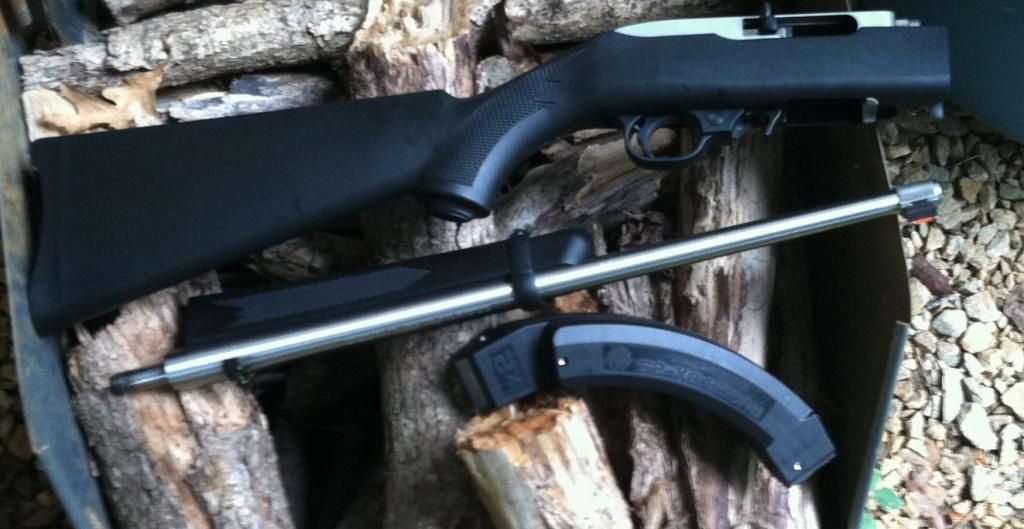
I purchased a Ruger 10/22 Takedown not long after they came out on the market.  I felt like it was time for my son to move up from the single shot bolt actions we had been working with so we took a trip to one of the local sporting goods stores, a locally owned one I might add and I let him pick one off the wall.

At the ripe old age of 11 his criteria for a rifle is quite a bit different than mine.  He chose the Takedown because it was stainless steel and synthetic, it looked cool, and it came with a really cool bag.  Come to think of it, maybe our criteria aren't that different after all...

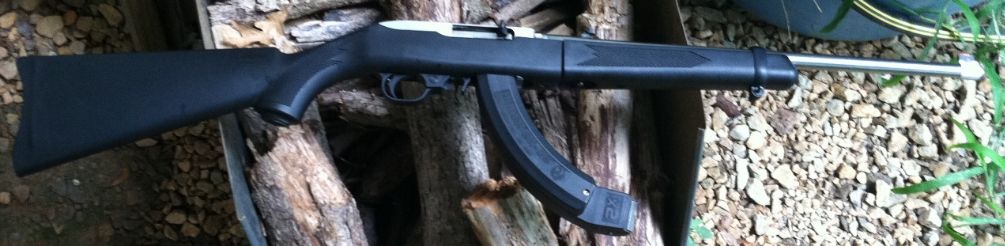
The 10/22 TD, according to Ruger's website weighs in at 4.67 pounds, has a 13.5" Length of Pull (the distance from the buttstock to the trigger,) a barrel length of 18.5" and an overall length of 37".  It accepts the standard 10/22 magazines and comes with the standard gold bead front blade sight and windage and elevation adjustable rear sight.  The package also included a single 10 round magazine.  Ruger claims the rifle will hold zero after reassembly if procedures are followed.  The bag has MOLLE type webbing for a couple of small attachements, two zippered pockets on the outside and three velcro compartments on the inside.  It makes a great storage option for a vehicle or home.

One of the very first things I did was to ditch the stock sights.  I replaced them with a set of TruGlo Fire Sights.  The TruGlo sights required a fair amount of hand fitting to get them on the rifle.  I had to shim the rear sight and do quite a bit of extensive filing on the front sight.  A word of caution, if you take it upon yourself to fit a set of sights to any gun, do the filing on the sights and not the gun.  Once you change the profile of the dovetails you'll have to hand fit any other changes you make at a later date, including trying to reinstall the original sights.

A quick side note on the TruGlo sights, the front inserts can be changed for different colors.  We chose orange as it seemed to be more visible to both my son and myself.  We've not lost or had an insert broken yet.

As of this writing we have ran approximately 5000 rounds through the 10/22 TD.  Due to the current difficulties in obtaining .22 LR ammo that has been 5000 rounds of whatever I could get my hands on.  The list includes but is not limited to;
Winchester Bulk Pack
Federal Auto Match
Federal Champion
Remington Golden Bullet
Remington New & Improved Golden Bullet
Remington Target Standard Velocity
Aquila SuperExtra plated
Aquila SuperExtra lead
Sellior & Bellot HV HP
CCI Stingers
CCI Standard
Winchester Super X
and about 500 rounds of loose ammo my brother gave my son.

If you're looking for a list of groups and measured velocities you won't find them here.  First I don't have a chronograph.  Secondly while we both have shot squirrels with the 10/22 TD that's not the kind of shooting it sees most of the time.  We share the rifle for shooting steel matches.  Mostly a local version of the former Ruger Rimfire Challenge which is now the NSSF Rimfire Challenge.  The bottom line is, the dang thing runs with just about any ammo we've fed it.  The two brands that most notably come to mind as being problematic are the Remington Golden Bullet and the Winchester Bulk.  Both had feeding and ignition issues.

Accuracy out of every brand of ammo was Minute of Squirrel at 25 yards.  Sorry folks, I haven't benched the rifle to zero it and measured groups.  I can hit a plastic water bottle at 50 yards, so that's about as technical as it's gonna get.

At this juncture you're probably scratching your head and wondering how any of this information pertains to a survival gun.  I think of competition shooting as auto racing.  Equipment sees hard use and little maintenance during matches.  Being able to drive a stock rifle in a drag racing style event with no failures and hitting the targets, some of which are quite small will show any weaknesses quickly.  Sights, action, magazines, ammo, etc. if there's a weak link it will snap at the least opportune time.  So If I can load up a BX-25 magazine, shoot a course of fire four times using up twenty of the twenty five rounds in the magazine, run each course of fire in less that 2.5 seconds engaging five targets that require transitioning and have no equipment failures then in my mind I've got a pretty decent setup.  Reliability is the key.  So let's apply what we have to a survival setting.


The gun is compact and light weight.  It's fairly accurate.  It will feed almost any ammo reliably.  It will work in suboptimal conditions. The Length of Pull and weight allow it to be used by smaller framed people as well as big, hulking brutes.  It's based on one of the most popular brands of .22 rifles made.  That means magazines are relatively inexpensive and accessories are readily available.  Ammo is lightweight and easy to pack.  There are dozens of options for ammunition with various velocities, bullet weights, bullet designs and intended applications.

 So what are the downsides?  It's a .22.  While I'm not a caliber snob by any stretch it does have limitations.  It's not the best choice for anything larger than small game.  It's not the best choice for self defense either but, I'll be the first to recommend a .22 for a smaller framed person, someone with grip issues making cycling a slide or manipulating a double action trigger difficult if not impossible or folks that are sensitive to recoil and/or noise.  A .22 rifle with a magazine holding twenty five rounds can lay down a tremendous volume of accurate fire.  We teach that shot placement trumps caliber, penetration, expansion, and the myriad other 'criteria' for a defensive firearm.  Simply put, if you can't hit what you're shooting at, none of that other stuff matters.

It's not my first choice for a survival gun.  It's not even my second or third.  However if it's all I had close to hand, I wouldn't hesitate to pick it up, assemble it and drive on with my mission of getting out of whatever situation I've found myself in that might require a firearm.  If you're looking for a well built, accurate, robust firearm for plinking, survival, general vermin eradication or even self defense that comes in less that $400 you might want to take a bit of time and research the Ruger 10/22 Takedown.